
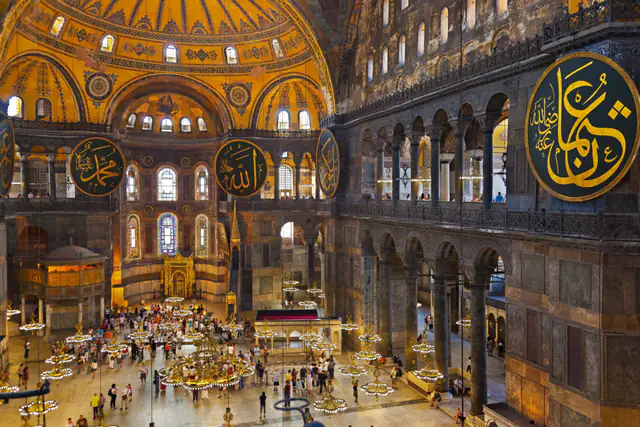
In 2026, tourists mainly experience Hagia Sophia from the upper gallery route. From there you can see the great dome, Byzantine mosaics, Ottoman calligraphy panels, marble columns and some of the best interior photo angles.
Quick answer
Tourist access inside Hagia Sophia normally follows the paid upper gallery route. From there, focus on the great dome, Byzantine mosaics, Ottoman calligraphy panels, marble columns and the elevated view over the prayer hall. Ground-floor prayer areas operate separately.
What Can Tourists See Inside Hagia Sophia?
Visitors should expect a marked upper-gallery visitor route rather than a completely open museum-style floor plan. The paid tourist experience gives elevated views of the dome, gallery arcades, mosaics and the prayer hall below.
This is why the upper gallery matters: it is not only a viewpoint, it is the part of the visit where many of Hagia Sophia's most important historical details become easier to understand.
For ticket context, see the Hagia Sophia ticket price guide, the upper gallery guide and the visitor route guide.
What Does Hagia Sophia Look Like Inside?
The interior feels much larger than many visitors expect. Photos rarely capture the scale of the central space, the height of the dome or the way light enters the building.
The experience combines Byzantine architecture, Islamic art, ancient marble, Christian mosaics and a living mosque atmosphere.
Why Is The Interior So Famous?
Hagia Sophia's interior is famous because it brings together massive open space, ancient mosaics, Islamic calligraphy, marble decoration, natural light and nearly 1,500 years of history.
It is not one feature alone. It is the combination of many eras under one dome.
The Great Dome
The dome rises approximately 55 meters above the floor and appears almost weightless because of the windows around its base.
When sunlight enters through those windows, the dome seems to float, which is one reason architects have studied Hagia Sophia for centuries.
The Marble Columns
The columns came from different parts of the Byzantine world, and some were already ancient when Hagia Sophia was built.
Look closely and you will notice different colors, proportions and materials. The columns are part of the building's imperial story.
The Giant Calligraphy Panels
The enormous circular calligraphy panels were added during the Ottoman period and display important Islamic names and phrases.
Their scale creates a powerful contrast with the Byzantine structure and surviving Christian imagery.
The Christian Mosaics
Christian mosaics are among Hagia Sophia's greatest treasures. Key works include the Virgin Mary Mosaic, the Deesis Mosaic and imperial mosaics in the gallery areas.
Many visitors miss details because the mosaics are high above eye level, so slow down and use zoom if needed.
The Imperial Door And Marble Floor
The Imperial Door was historically associated with emperors and ceremonial movement through the building.
The marble floor also deserves attention. Some patterns look like abstract landscapes and were valued as natural decoration.
Best Photo Spots Inside
For scale, stand beneath or near the central dome. For mosaics and layout, the Upper Gallery offers some of the strongest interior views.
Avoid blocking worshippers or visitor flow, and do not use flash during prayer-sensitive moments.
Local Tips From Istanbul
- Visit early in the morning if this topic matters to your experience.
- Look up often; many of Hagia Sophia's most important details are above eye level.
- Use the Upper Gallery for better context, photos and architectural perspective.
- Book with enough time around prayer periods and Sultanahmet crowds.
Pair the interior visit with Basilica Cistern
If you enjoy Hagia Sophia's interior, Basilica Cistern is the most logical next stop. It continues the Byzantine story underground and works well as a short add-on after the upper-gallery route.
Basilica Cistern fast-track guided ticket
FAQ
Can you go inside Hagia Sophia?
Yes. Visitors are welcome outside prayer times and according to current visitor rules.
What is inside Hagia Sophia?
The interior includes mosaics, marble columns, calligraphy panels, a massive dome, historic doors and gallery views.
Are the mosaics still visible?
Yes. Several major Byzantine mosaics remain visible.
What is the most famous feature inside Hagia Sophia?
The great central dome is generally the most famous feature.
How long should I spend inside?
Most visitors spend between 1 and 2 hours.
Final Thoughts
Hagia Sophia is not just one attraction or one historical label. It is a layered landmark where Byzantine, Ottoman, Christian, Islamic and modern Istanbul stories meet under the same dome.
Hagia Sophia Ticket & Visitor Guide
Skip the ticket-office line · AR experience · audio commentary in 23 languages · from €28.00