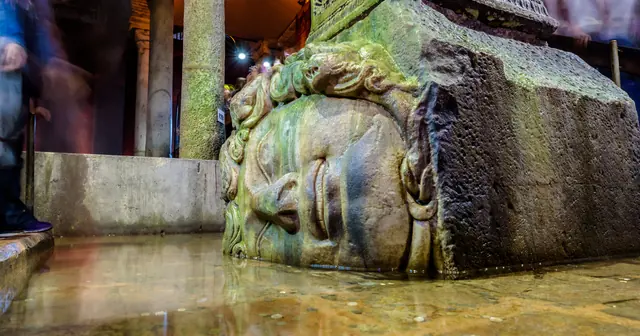
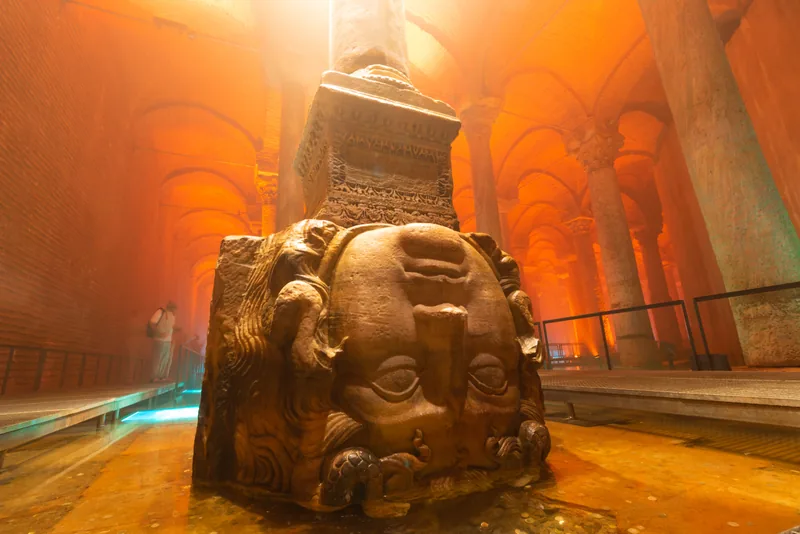
The two Medusa heads are the most recognizable details inside Istanbul's Basilica Cistern. Both are ancient carved stone blocks reused beneath columns, but one lies upside down and the other is turned sideways.
Quick answer
The Medusa heads are near the far end of the marked visitor route. Official material dates the reused Roman relief blocks to around the fourth century. Their original building and the precise reason for their unusual orientation are not documented, so confident explanations should be treated as theories.
What Are the Medusa Heads?
They are carved architectural blocks depicting Medusa, the mythological figure whose gaze turned people to stone. They were reused as bases beneath two columns when the cistern was built during the reign of Byzantine Emperor Justinian I in the sixth century.
Reusing older Roman stone was common in Constantinople. The official Basilica Cistern guide describes both blocks as Roman works generally dated to the fourth century, but their exact place of origin remains unknown.
Why Is One Upside Down and One Sideways?
No surviving record gives a definitive answer. The most cautious explanation is practical reuse: the blocks were available pieces of stone adapted to support columns at the required height.
You may also encounter symbolic theories claiming the positions were intended to neutralize Medusa's gaze. They make an interesting story, but there is no firm historical evidence proving that purpose.
Known: two ancient Medusa relief blocks were reused as column bases. Not known: their original monument and the exact reason one is inverted and one is sideways.
Where To Find Them
Follow the marked route toward the far end of the cistern and watch for the Medusa signs. The heads sit beneath columns close to one another, but the viewing area can become busy when several groups arrive together.
- Do not turn back before reaching the final part of the route.
- Look at both bases: their orientation and carving are different.
- Allow a few extra minutes if you want a clear photograph.
Best Photo Tips
The lighting is deliberately atmospheric, so a steady hand and night mode help. Avoid flash, keep the walkway clear and wait briefly for a gap rather than blocking the route. A wider frame shows how each carving supports its column; a closer frame captures the worn facial details.
How Much Time Do You Need?
Most visitors spend 30 to 60 minutes in the entire cistern. The Medusa area itself needs around 5 to 10 minutes, depending on crowds and how much you want to photograph.
For current entry windows, see our Basilica Cistern opening hours guide. If you prefer the darker evening atmosphere, compare the daytime and Night Shift experience.
Pair the Cistern With Hagia Sophia
Basilica Cistern is about a 5–7 minute walk from Hagia Sophia, making the two a natural same-day pair. Start with Hagia Sophia, then continue underground and save the Medusa heads for the final part of the cistern route.
Use our Hagia Sophia to Basilica Cistern walking guide for the simplest route.
Book Basilica Cistern
Fast-Track Entry + Multilingual Audio
Self-guided entry with smartphone audio. Ticket prices and availability can change; confirm the final details before payment.
FAQ
Where are the Medusa heads?
They are beneath two columns near the far end of the marked visitor route inside Basilica Cistern.
Why are they upside down and sideways?
The exact reason is unknown. Practical reuse is the safest explanation; symbolic interpretations are theories, not documented fact.
How old are the Medusa heads?
Official Basilica Cistern material generally dates the reused Roman relief blocks to the fourth century.
Can I take photos?
Photography is normally possible. Follow current on-site rules, avoid flash and keep the walkway clear.